COGNITIVE REASONING / RESEARCH BETA
A pattern to notice.
A cell to build.
Look for relationships across visual matrices, then build the missing piece. Explore performance on one kind of reasoning task, with room for the conditions of your session.
2 guided examples + 22 scored items · untimed · no account
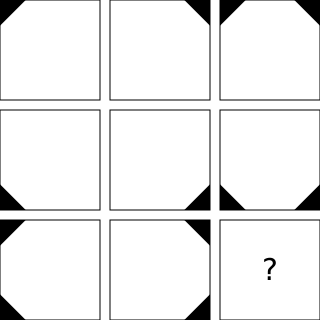
Think across.
Build the next step.
Construct, rather than guess.Use 20 visual elements to compose the missing cell. Choose every element that belongs.
A raw result, with boundaries.See the number of exactly correct constructions out of 22. This is not an IQ score or population percentile.
Untimed and private.Practice the controls, work at your pace, and pause on this browser. Your responses are processed locally.
HOW THE SESSION WORKS
Notice a relationship.
Construct a response.
Rows and columns may combine, remove, or change visual elements. Look across the whole matrix before building the missing bottom-right cell.
- Learn with two guided examples.
Try the controls and check an explanation. These Ownfacet practice illustrations are not scored or drawn from the 22-item form.
- Work through 22 source items.
Use checkboxes to add and remove elements. Your cell updates as you work. You choose when to continue, and can revise earlier submissions.
- Review, then view the raw total.
Scored items give no correctness feedback. Each exact match earns one point; there is no partial credit or conversion to an intelligence score.
SOURCE, SCORING & LIMITS
A research source.
An honest boundary.
Open Matrices Item Bank (OMIB), Koch et al. (2022). We use the 22 keyed Set 1 items in the published worksheet order.
Look for the relationships across the matrix, then build the missing bottom-right cell from the 20 available elements. Select every element that belongs, and leave all other elements unselected.
One point for an exact match to the published solution; no partial credit. The two practice examples do not count toward the result. An unsolved item is a deliberate submission of an empty cell and normally earns zero. An untouched item is left unanswered until you choose a construction or explicitly submit it as unsolved.
This assessment measures performance on these visual reasoning tasks. It does not produce an IQ score, a population percentile, a diagnosis, or a complete cognitive profile. This fixed subset and Ownfacet’s untimed digital administration have not been independently validated.
The published bank was calibrated with medical-school applicants. That selected sample does not supply general-population, age-adjusted IQ norms for this website. We do not use the published calibration parameters to infer ability, percentile ranks, or statistical confidence.
The tasks are visual. Element names and keyboard controls support interaction, but do not create an equivalent nonvisual assessment. You can enlarge a matrix; device size, vision, familiarity, interruptions, and outside help can affect the result.
There is no countdown. Set aside time when you can focus; we have not independently measured a typical duration. Retakes use the same items, so a change in score may reflect practice or familiarity.
BEGIN WITH THE CONTROLS
Take a moment.
Look for the pattern.
Start with a guided example and make the construction controls familiar before the scored items begin.
Start the practice examples