Nietzschean Aristocratism
Nietzschean current that rejects egalitarian morality as herd resentment, defending a hierarchy of values, the aristocratic creation of meaning and the tragic affirmation of life after the death of God.
Ownfacet / Politype / Ideologies / Nietzschean Aristocratism
Nietzschean current that rejects egalitarian morality as herd resentment, defending a hierarchy of values, the aristocratic creation of meaning and the tragic affirmation of life after the death of God.
EDITORIAL SUMMARY
I want to affirm life beyond herd morality, creating an aristocratic hierarchy of values after the death of God.
Sources below support the specific identity or context claims indicated. They do not validate this profile’s editorial category labels, twelve numerical coordinates, closest matches, or every statement in its description.
Review statuses describe scoped, agent-assisted checks against cited sources. They are not an independent human expert certification.
A documented source review is still pending for this entry. Treat its description and coordinates as an atlas interpretation.
How to interpret catalog profilesPolitical Axes
These coordinates are editorial interpretations. The two pole scores add to 100; they describe a position in this model, rather than a probability. Read how catalog profiles are interpreted ↗
This position is 43.8 points from the median of the 257 ideology profiles in this collection.
This is the largest distance from this collection’s median across the twelve axes. The collection is not a survey of public opinion.
This position is 1.3 points from this collection’s median.
This is the smallest median distance across the twelve axes; it does not establish a historical or political consensus.
Scores below are similarity indices out of 100, calculated from catalog coordinates. They do not establish historical influence or endorsement. How the comparison works ↗
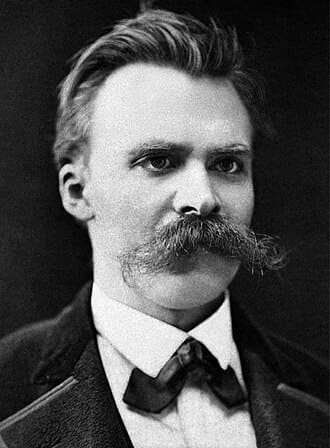
A German philosopher, Nietzsche attacked egalitarian morality, Christianity, and modern resentment, defending the aristocratic creation of values, the affirmation of life, and the overcoming of inherited moral conventions.
Closest by facet
Each facet compares three axes: governance (power distribution, representation, civil liberties), culture (integration, religion, social norms), or economy (ownership, coordination, trade). Full-profile similarity compares all twelve.
Other nearby figures




Most distant figures
Scores below are similarity indices out of 100, calculated from catalog coordinates. They do not establish historical influence or endorsement. How the comparison works ↗
Related Doctrines
Scores below are similarity indices out of 100, calculated from catalog coordinates. They do not establish historical influence or endorsement. How the comparison works ↗
Most compatible among the 257 schools
A doctrine of Curtis Yarvin that proposes running the state as a joint-stock company: shareholders, a sovereign CEO, citizens as customers who can leave, guaranteed private property and politics replaced by management.
Current that advocates accelerating the system's contradictions through technology and the collapse of liberal institutions, betting on the rupture of the existing order to forge a new social and political hierarchy.
Centrism taken to its limit: it refuses any leaning on principle and seeks exact equidistance between every pole, from economics to morality, treating each political axis as a balance point to be preserved.
Most distant ideology
Clerical FascismThird position52.7 / 100