Agrarian Socialism
Current that builds socialism from the countryside, with a single party, collectivization into villages and cooperatives, food self-sufficiency and protection of land and forests, as in Nyerere's Ujamaa.
Ownfacet / Politype / Ideologies / Agrarian Socialism
Current that builds socialism from the countryside, with a single party, collectivization into villages and cooperatives, food self-sufficiency and protection of land and forests, as in Nyerere's Ujamaa.
EDITORIAL SUMMARY
I want socialism built from the countryside, with collective villages, food grown at home, protected forests and a party guiding the nation.
Sources below support the specific identity or context claims indicated. They do not validate this profile’s editorial category labels, twelve numerical coordinates, closest matches, or every statement in its description.
Review statuses describe scoped, agent-assisted checks against cited sources. They are not an independent human expert certification.
A documented source review is still pending for this entry. Treat its description and coordinates as an atlas interpretation.
How to interpret catalog profilesPolitical Axes
These coordinates are editorial interpretations. The two pole scores add to 100; they describe a position in this model, rather than a probability. Read how catalog profiles are interpreted ↗
This position is 36.3 points from the median of the 257 ideology profiles in this collection.
This is the largest distance from this collection’s median across the twelve axes. The collection is not a survey of public opinion.
This position is 1.2 points from this collection’s median.
This is the smallest median distance across the twelve axes; it does not establish a historical or political consensus.
Scores below are similarity indices out of 100, calculated from catalog coordinates. They do not establish historical influence or endorsement. How the comparison works ↗
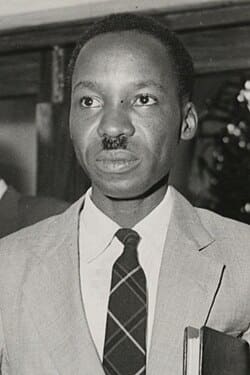
The father of Tanzania's independence, Nyerere created Ujamaa, an African socialism based on communal villages, self-reliance, and national unity above ethnicity.
Closest by facet
Each facet compares three axes: governance (power distribution, representation, civil liberties), culture (integration, religion, social norms), or economy (ownership, coordination, trade). Full-profile similarity compares all twelve.

Other nearby figures




Most distant figures
Scores below are similarity indices out of 100, calculated from catalog coordinates. They do not establish historical influence or endorsement. How the comparison works ↗
Related Doctrines
Scores below are similarity indices out of 100, calculated from catalog coordinates. They do not establish historical influence or endorsement. How the comparison works ↗
Most compatible among the 257 schools
Current of Sankara, Samora Machel, Nkrumah and Nyerere joining pan-Africanism, Black consciousness, anticolonial struggle, agrarian collectivization and self-reliance against neocolonialism and racism.
Revolutionary model that idealizes peasant life and collective rural production, rejecting cities, markets, and private property in favor of an equality imposed by state mobilization and communal discipline.
Latin American project that combines popular nationalism, anti-imperialism, social redistribution, and strong presidential leadership, using the state and strategic resources to promote sovereignty and popular inclusion.
Most distant ideology
Crypto-AnarchismLibertarian40.2 / 100